
Military and defense communication systems may be deployed in environments where ordinary commercial cabling is not designed to operate.
A cable may be repeatedly deployed across rough ground, installed inside a vibrating vehicle, exposed to salt spray aboard a ship or routed through an outdoor command site. In these environments, a cable failure can interrupt communications, sensing, surveillance or control functions.
Military-grade fiber optic cable is designed to address these risks through rugged mechanical construction, controlled optical performance and application-specific environmental testing.
However, the term military-grade does not describe one universal cable design. A tactical field cable, shipboard cable, aircraft cable and permanently buried military cable may have substantially different requirements.
A product should therefore be considered military-compliant only when it meets the specific specification, detail sheet, qualification requirement and test program stated in the procurement document.
In commercial marketing, “military-grade” is sometimes used loosely to describe a rugged product. In a formal defense procurement context, the term should have a more precise meaning.
A cable or assembly may need to comply with one or more of the following:
There is no single MIL specification covering every type of military fiber optic cable.
For example, the MIL-PRF-85045 family includes separate specification sheets for different cable constructions, fiber counts, temperature ranges and airborne or shipboard applications. Active sheets include single-fiber tight-buffered cable, loose-tube cable, flexible ribbon cable and enhanced-performance shipboard configurations.
A cable qualified for one detail sheet should not automatically be presented as suitable for every military platform.
These terms should not be treated as interchangeable.
A ruggedized cable incorporates additional protection such as:
It may perform well in industrial, emergency-response or temporary outdoor applications without being formally qualified to a military specification.
A military-specification cable is manufactured and tested according to an identified military specification or customer drawing.
Depending on the procurement requirement, compliance may involve:
A rugged construction alone does not prove MIL-SPEC compliance.
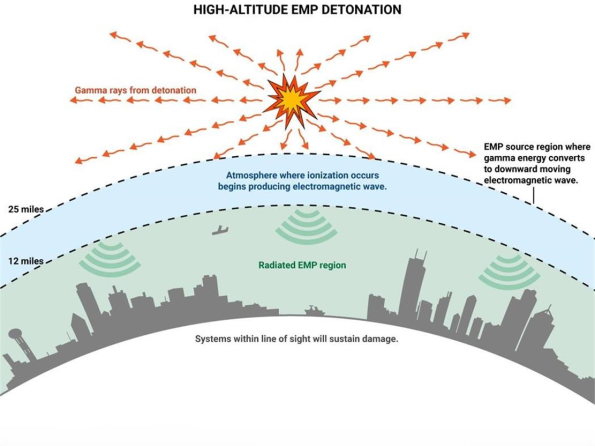
Optical fiber transmits information using light rather than electrical current. The optical transmission medium is therefore not affected by electromagnetic interference in the way that copper conductors are.
This is useful near:
The complete system is not automatically immune to every electromagnetic threat. Transceivers, switches, power supplies, metallic armor and equipment enclosures may still need to satisfy applicable electromagnetic-environment requirements.
MIL-STD-461 establishes EMI emission and susceptibility requirements for certain defense electronic equipment and subsystems, while MIL-STD-464 addresses electromagnetic environmental effects at the system level.
A fully dielectric fiber optic cable does not provide a conductive metallic path between connected locations.
This can be beneficial when connecting:
If electrical isolation is required, metallic armor, metallic strength members and conductive connector shells must be considered separately.
Single-mode and multimode fibers can support high-data-rate transmission when paired with suitable optical transceivers.
Military applications may carry:
The cable itself does not define the final data rate. Capacity depends on the fiber, transceivers, wavelengths, modulation format and system architecture.
Fiber can consolidate substantial communication capacity into relatively small cables.
This may reduce the number of copper pairs required, although total assembly weight depends on armor, connectors, reels, breakout hardware and environmental protection.
A passive optical fiber does not radiate the same electromagnetic field as a copper communication conductor.
This can reduce some forms of electromagnetic interception. It does not make a network impossible to tap.
Secure systems still require:
The applicable standard depends on whether the procurement concerns the fiber, cable, connector, terminus, installation or environmental test method.
MIL-PRF-49291 is a performance-specification family for optical fiber.
Its detailed specification sheets cover different optical-fiber types and performance characteristics. Some active sheets specifically address radiation-resistant fiber and enhanced aircraft-related performance.
This specification concerns the optical fiber itself and should not be presented as a complete tactical-cable or connector standard.
MIL-PRF-85045 is a major performance-specification family for military fiber optic cables.
Its detail sheets cover configurations such as:
Different sheets specify different application, construction and environmental requirements.
A supplier should state the exact applicable detail sheet rather than only saying “MIL-PRF-85045 compliant.”
MIL-DTL-83526 covers circular, environmental-resistant, hermaphroditic fiber optic connectors designed for rugged military field applications.
Hermaphroditic interfaces allow compatible cable assemblies to be connected without separate male and female cable-end configurations.
This connector type is commonly associated with deployable tactical fiber systems.
MIL-PRF-28876 covers circular plug-and-receptacle fiber optic connectors using multiple removable termini.
The specification includes connector shells, inserts, retention components, backshells and protective covers for defense applications.
Associated removable fiber optic termini may be covered by MIL-PRF-29504 detail sheets.
MIL-STD-2042 provides standardized methods for the selection, handling, installation, interconnection, repair and testing of fiber optic cabling on surface ships and submarines.
Different parts address:
Compliance of a cable component does not remove the need for compliant installation and testing procedures.
MIL-STD-810 provides environmental-engineering guidance and laboratory test methods.
It is not a single universal certification with one fixed test sequence. The standard specifically uses an environmental-tailoring process in which the applicable stresses and methods are selected according to the product’s expected service environment.
A claim such as “MIL-STD-810 tested” should therefore identify:
MIL-STD-167-1 defines procedures and requirements for environmental and internally generated vibration testing of specified naval shipboard equipment.
Whether it applies directly to a cable, connector, assembly or supporting equipment depends on the procurement and installation requirements.
MIL-DTL-38999 is a general specification for high-density, environmental-resistant circular electrical connectors.
Fiber optic termini may be incorporated into certain compatible connector systems, but MIL-DTL-38999 is not by itself a generic military fiber optic cable standard.
MIL-DTL-24643 covers low-smoke, halogen-free electrical cables for Navy shipboard applications.
It should not be cited as though it were the primary general specification for fiber optic cable.
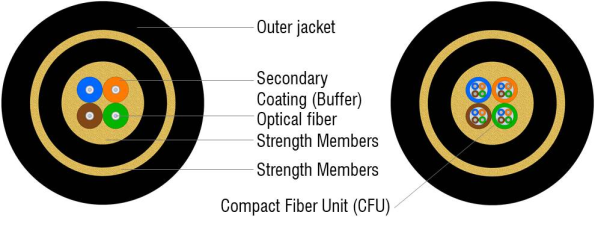
Military cable construction varies significantly by application. A typical rugged assembly may contain several of the following elements.
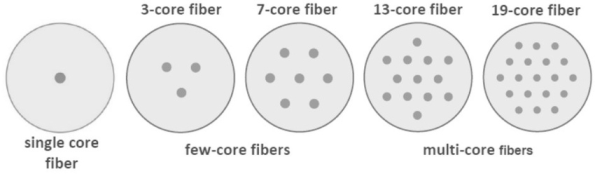
Available fiber types may include:
The correct fiber must match the transceiver wavelength, distance, launch condition and environmental requirement.
The fiber does not become “military-grade” simply because it is placed in a heavy jacket. Its optical and environmental specifications must also satisfy the required standard.
The glass fiber normally has a primary protective coating.
Additional cable constructions may use:
Tight-buffered cable can provide:
Loose-tube cable can provide:
Neither construction is universally stronger. Performance depends on the complete design and tested requirements.
Common strength members include:
They help transfer pulling loads away from the optical fibers.
Required tensile strength should be stated in newtons or pounds-force together with:
Outdoor and marine cables may include:
Water resistance must be verified through the applicable test method. Metal armor alone does not make a cable waterproof.
Armor may be added for:
Possible constructions include:
Metallic armor may require bonding or grounding and may eliminate some of the electrical-isolation advantages of an all-dielectric cable.
Common rugged-jacket materials include:
Selection may depend on resistance to:
No jacket material provides every property equally well.
Military and tactical assemblies may use:
Connector selection affects:
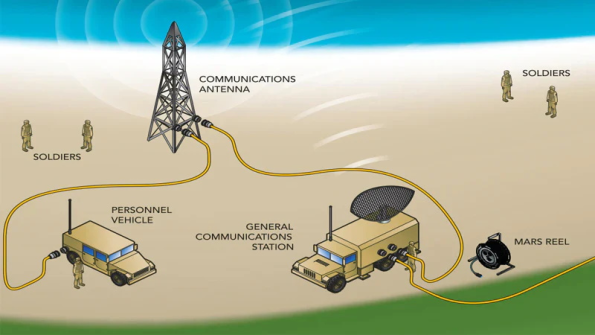
Tactical cable is designed for repeated deployment and retrieval.
Typical characteristics may include:
It may be used between temporary command posts, mobile shelters, sensors and field equipment.
A tactical cable should not be described as vehicle-proof unless a specific crush or vehicle-overrun test has been completed.
Shipboard cable may need to address:
MIL-PRF-85045 contains multiple shipboard-oriented cable detail sheets, while MIL-STD-2042 addresses shipboard installation and testing.
Aircraft and vehicle cables may prioritize:
The exact temperature and vibration ranges must come from the applicable platform specification rather than a generic military-grade value.
Permanent facilities may use cables designed for:
These cables may be heavier and less flexible than tactical cable because repeated deployment is not the primary requirement.
Radiation-resistant fibers are designed to limit radiation-induced attenuation in specified environments.
MIL-PRF-49291 includes active detail sheets for radiation-resistant optical fibers.
Radiation resistance must be specified by:
The phrase “radiation hardened” alone is insufficient for technical selection.
Hybrid assemblies may combine:
They can reduce the number of separate cables, but they require more careful consideration of electrical safety, EMI, connector design and repair procedures.
Fiber supports high-capacity transmission over distances that would be difficult for conventional copper data cabling.
Actual reach is determined by the transceiver standard and optical link budget.
The optical path is not affected by electromagnetic interference generated by nearby electrical equipment.
A properly designed tactical or armored cable can reduce damage from:
The exact resistance must be established through product testing.
Pre-terminated tactical assemblies and hermaphroditic connectors can reduce setup time and simplify extension of temporary fiber links.
All-dielectric cable can prevent ground-current flow between network locations.
The optical medium does not emit the same electromagnetic field as copper communication lines.
Encryption and physical security remain necessary.
Rugged jackets, specialized connectors, low-volume production, qualification tests and traceability can increase product cost.
There is no reliable universal multiplier such as “five to eight times commercial price.”
Armor and reinforcement may increase:
Lightweight tactical cable and heavy direct-burial cable should not be compared as though they were the same product class.
Physical-contact fiber connectors require inspection and cleaning.
Dust or contamination can cause:
Expanded-beam connectors may tolerate dirty field conditions better in some applications but may have different loss and cost characteristics.
Field repair may require:
Pre-terminated replacement sections and modular connectors may simplify maintenance.
Fiber is harder to monitor through electromagnetic induction, but it can still be physically accessed or tapped.
Secure network design still requires encryption, authentication and route protection.
| Selection Factor | Questions to Confirm |
|---|---|
| Applicable specification | Which exact MIL specification, detail sheet or customer drawing applies? |
| Qualification | Is QPL/QPD qualification required, or is test-report compliance sufficient? |
| Application | Tactical, shipboard, airborne, vehicular, buried or fixed installation? |
| Fiber type | OS2, multimode, bend-insensitive, radiation-resistant or specialty fiber? |
| Fiber count | How many active and spare fibers are required? |
| Cable construction | Tight-buffered, loose-tube, ribbon, breakout or hybrid? |
| Deployment frequency | Permanent installation or repeated reel deployment? |
| Temperature | Required installation, operating and storage ranges? |
| Mechanical performance | Tensile, crush, impact, torsion, flexing and bend-radius requirements? |
| Moisture | Rain, immersion, water blocking, salt fog or direct burial? |
| Chemical exposure | Fuel, oil, hydraulic fluid, solvents or decontamination agents? |
| Flame and smoke | Which platform-specific flame, smoke and toxicity requirements apply? |
| Electrical isolation | Must the cable be completely dielectric? |
| Connector | MIL-DTL-83526, MIL-PRF-28876, expanded beam or another interface? |
| Optical performance | Maximum insertion loss, return loss and attenuation? |
| Mating durability | How many connection cycles are required? |
| Repair method | Field splice, replaceable assembly or removable termini? |
| Documentation | Certificate of conformance, raw test data, first-article report or traceability? |
Before purchasing a product described as military-grade, request the precise evidence supporting the claim.
Relevant documentation may include:
A statement such as “designed to meet MIL-STD-810” is not equivalent to proof that a specific configuration passed defined MIL-STD-810 methods and procedures. MIL-STD-810 itself requires environment-specific tailoring rather than one generic certification sequence.
Depending on the specification, an assembly may be evaluated for:
Test values and procedures must come from the applicable specification or contract.
A completed cable assembly may require:
Measures total optical loss through the cable and connectors.
Measures reflected optical power, particularly for single-mode physical-contact connectors.
Can help identify:
Checks for:
Confirms that every fiber is connected to the correct position at the opposite end.
MIL-STD-2042 includes detailed shipboard methods for fiber selection, handling, connector installation and completed-installation testing.
The phrase alone does not define temperature, tensile strength, fiber type or connector.
A range such as −55°C to +85°C may apply to some components, but not every military cable.
A thick armored cable may be inappropriate for a lightweight tactical or airborne application.
The optical fiber is immune to normal EMI, but the connected electronics and conductive structures still require system-level engineering.
MIL-PRF-85045 contains multiple configurations. Stating only the base specification may be insufficient.
A qualified cable can still fail if it is pulled beyond its rating, bent too tightly, contaminated or terminated incorrectly.
The connector, backshell, cable entry and cable jacket must all satisfy the required environmental sealing level.
Commercial connectors may be suitable inside protected equipment, but exposed tactical links may require a sealed rugged interface.
No.
A ruggedized cable may provide excellent mechanical and environmental performance without being qualified to a military specification.
Only when the exact cable assembly has a tested vehicle-overrun or crush rating sufficient for that load and surface condition.
“Military-grade” alone does not guarantee vehicle-overrun survival.
The optical transmission medium is not affected by EMI in the same way as copper conductors.
The complete network still contains electronics, power supplies, enclosures and possibly metallic armor. System-level EMP or electromagnetic-environment performance must be separately designed and verified.
No.
Many tactical cables rely on flexible polyurethane jackets and aramid strength members rather than heavy metallic armor. Excessive armor can make repeated deployment more difficult.
Tactical cable prioritizes flexibility, repeated deployment and field handling.
Direct-burial cable prioritizes moisture protection, crush resistance and long-term underground service.
It depends on the application.
Protected internal links may use commercial connector formats. Exposed field links may use MIL-DTL-83526, MIL-PRF-28876, expanded-beam or other rugged interfaces.
No.
Fiber does not radiate the same electromagnetic signal as copper, but physical tapping remains possible. Encryption and route monitoring should still be used where security is critical.
The optical signal already has inherent immunity to electromagnetic interference.
Metallic armor primarily provides mechanical protection and may create additional bonding or grounding requirements.
Request the applicable specification, detail sheet, qualification status, manufacturer part number and supporting test documentation.
Military-grade fiber optic cable is not one universal product category. It is a family of application-specific cables and assemblies designed to satisfy identified military, platform or contract requirements.
A tactical cable optimized for repeated deployment may be lightweight and flexible. A shipboard cable may prioritize vibration, smoke and installation requirements. A buried cable may require armor and water blocking, while an airborne cable may prioritize minimum weight and diameter.
The most important selection factors are:
Sunma can supply customized ruggedized fiber optic cables and assemblies with single-mode or multimode fibers, reinforced jackets, armored constructions and rugged connector options. Any military-standard compliance claim should be tied to the exact product configuration, applicable specification and available qualification or test documentation.

 English Home
 简体中文
简体中文 Online Message
 Skype
Skype
 QQ:20181072

