
UTP cable is commonly used to connect switches, routers, computers, wireless access points and other Ethernet devices. A twisted pair UTP cable contains insulated copper conductors arranged in pairs, with each pair twisted to help control interference and maintain signal quality.
Understanding how this structure works can help you select the right cable category, conductor gauge and shielding type for your network.
UTP stands for Unshielded Twisted Pair. A standard Ethernet UTP cable normally contains eight copper conductors arranged into four color-coded pairs.
Unlike shielded Ethernet cable, UTP does not use metallic foil or braided shielding. Instead, it relies mainly on balanced signal transmission and the physical twisting of each wire pair to reduce interference.
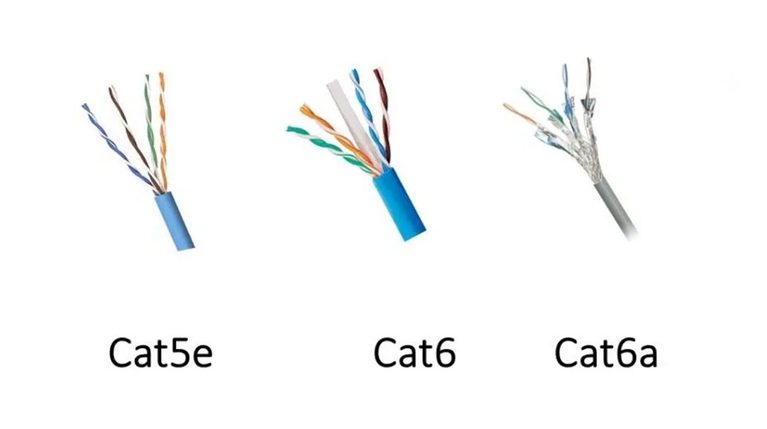
Common UTP cable categories include:
Cable category is important, but actual performance also depends on conductor quality, connector termination and installation.
A signal traveling through a copper conductor creates an electromagnetic field. This field can interfere with nearby conductors and introduce unwanted signals.
Twisting the two conductors in a pair continually changes their physical positions. This helps the receiving equipment reject noise that affects both conductors and reduces signal coupling between adjacent pairs.
The twisted structure helps control:
The four pairs usually have different twist rates. This prevents adjacent pairs from repeatedly aligning in the same position, which could increase interference between them.
Crosstalk occurs when the signal carried by one wire pair creates an unwanted signal in another pair.
Two common forms are:
Although pair twisting reduces crosstalk, a UTP cable is not completely immune to interference. Performance may be affected by poor termination, excessive bending, cable compression or installation near strong electrical noise sources.
To protect cable performance:
Cat6a is designed to support 10 Gigabit Ethernet at frequencies up to 500 MHz over a standards-compliant channel of up to 100 meters. It also provides improved control of internal and external crosstalk compared with lower cable categories.
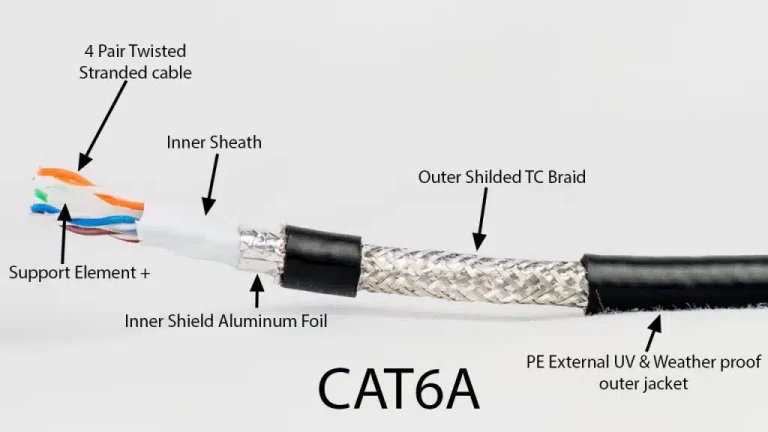
Cat6a UTP is suitable for many controlled indoor environments, including:
The FiberMart Cat6a UTP Ethernet patch cable is available in multiple lengths, colors and conductor gauges. Its listed options include 24AWG, 26AWG and 28AWG conductors, as well as PVC and LSZH jackets.
Strong-EMI environments may require a shielded alternative. Industrial equipment, high-current power systems and other electrical noise sources can increase the risk of interference. In these situations, consider a properly installed Cat6a S/FTP shielded patch cable.
A lower AWG number represents a larger conductor. The right choice depends on cable length, density, flexibility and PoE requirements.
The larger conductor generally provides lower electrical resistance. It may be suitable for longer connections or higher-power PoE applications, but the cable is usually thicker and less flexible.
This option provides a practical balance between conductor size and flexibility for many general patching applications.
The smaller cable diameter can improve airflow and cable management in high-density racks. However, cable length, bundle size and PoE load should be evaluated because smaller conductors have higher resistance.
AWG should not be selected by size alone. Always consider equipment requirements, channel length, ambient temperature and applicable cabling standards.
The jacket affects where the cable can be safely installed.
Check the local fire and building requirements before selecting a jacket material.
Before purchasing a UTP Ethernet cable, confirm:
For a standard Gigabit Ethernet installation, a Cat5e UTP patch cable may be sufficient. A Cat6 UTP Ethernet cable provides improved performance, while Cat6a is the stronger choice when a properly designed 10 Gigabit copper channel is required.
UTP is one type of twisted-pair cable. Its complete name is unshielded twisted pair. Shielded Ethernet cables also use twisted pairs but add foil, braid or both.
A standards-compliant Cat6a channel is designed to support 10GBASE-T over distances up to 100 meters. Actual performance depends on the complete channel, component quality and correct installation.
Yes. Compatible UTP cable can carry both data and electrical power. Conductor gauge, cable length, bundle size and operating temperature become especially important in higher-power PoE applications.
A twisted pair UTP cable controls interference by arranging its copper conductors into carefully twisted pairs. Preserving this structure during installation and selecting the correct category, gauge and jacket are essential for reliable network performance.
For 10 Gigabit connections in offices, equipment rooms and other controlled environments, explore the FiberMart Cat6a UTP Ethernet patch cable.

 English Home
 简体中文
简体中文 Online Message
 Skype
Skype
 QQ:20181072

